Steam Heat & Radiator Repair in Bay Terrace, Queens
Restoring quiet, balanced warmth to residential one-pipe and two-pipe steam systems throughout Bay Terrace, Fort Totten, and Clearview. We resolve cold radiators, violent water hammer, hissing air vents, and leaky radiator supply valves.
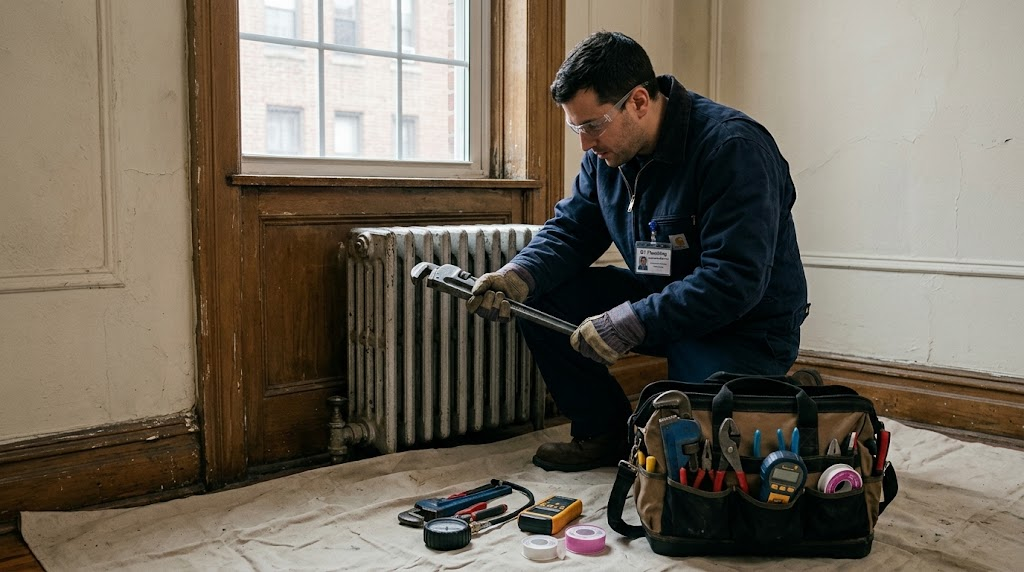
Diagnosing Cold Radiators & Uneven Steam Distribution
In many Bay Terrace brick row houses, co-ops near Fort Totten, and garden apartment complexes constructed in the mid-20th century, low-pressure steam heat remains the foundation of winter comfort. Yet when a radiator fails to heat up, the issue is seldom the boiler alone. Steam systems rely entirely on the displacement of air. At the conclusion of each heating cycle, steam cools, condenses into liquid water, and atmospheric air rushes back in through open vents to fill the cast-iron radiator chambers.
When the central boiler fires, steam travels along basement distribution mains and rises through vertical branch pipes. But steam cannot occupy the same volume as air. If an air vent on an individual radiator is plugged with dried mineral sediments, oil residues, or rust flakes, the cold trapped air acts as an impenetrable physical barrier. The incoming steam simply bypasses that room, leaving residents shivering while rooms closer to the boiler overheat. Replacing clogged or incorrectly calibrated vents with precision thermostatic air vents restores the rapid venting necessary for balanced steam flow.
Beyond individual radiator vents, the health of the entire distribution network relies upon basement main-line vents. When main vents stick closed, steam takes minutes longer to navigate basement mains, forcing the boiler to operate at excessive pressure that increases fuel costs and triggers boiler short-cycling. Read how boiler operation interacts with distribution on our Boiler Repair in Bay Terrace homepage.
Common Steam Radiator Symptoms
- Top or Bottom Half Cold: Restricted air venting or internal radiator scale.
- Continuous Vent Hissing: Thermostatic element failed to seal against steam vapor.
- Violent Banging & Clanging: Condensate trapped in unpitched pipes hitting incoming steam.
- Valve Stem Water Weeping: Degraded graphite packing washer around the valve spindle.
- Spurting Boiling Water: Surging boiler water level or reversed floor slope.
Emergency Radiator Support: For water dripping through ceilings or severe pipe banging, call our technicians immediately at (315) 202-8009.
Eliminating Water Hammer, Knocking & Pipe Pitch Faults
The startling, metallic clanging in steam pipes—known as water hammer—is not merely an annoyance; it creates extreme hydraulic pressure spikes capable of cracking cast-iron fittings and rupturing radiator valves.
1. One-Pipe Counterflow Physics
In single-pipe steam systems, steam travels uphill while returning condensed water must flow downhill along the bottom of the exact same horizontal runout pipe. If a house settles or flooring sags over decades, the pipe pitch can reverse or flatten. Condensed water pools into an artificial dam.
2. Hydraulic Shock Waves
When 212°F steam traveling at speeds up to 60 feet per second collides with pooled condensate, the steam condenses instantly, creating a localized vacuum. Water is sucked forward and hurled at supersonic velocity against elbows and valves, creating the violent bang.
3. Professional Realignment
We inspect the pitch of every radiator and horizontal runout. By installing precision cast-iron shims beneath radiator feet, adjusting pipe hangers in the basement, or refitting sagging runouts, we restore positive drainage so water flows effortlessly back toward the boiler.
Radiator Supply Valves, Steam Traps & Safe Maintenance
Proper mechanical care of steam terminal units protects flooring, wallpaper, and building structures from corrosive leaks.
Steam Radiator Valve Replacement
Radiator shut-off valves endure intense thermal cycling. Over years, the internal gland packing dries out, leading to steam leaks that damage parquet flooring and baseboards. Our technicians repack existing brass valves with high-density Teflon or graphite packing, or replace obsolete valves with heavy-duty cast-bronze steam valves designed for lifetime service.
In two-pipe steam systems common in older pre-war buildings, thermostatic steam traps on radiator outlets must also be inspected. A blown steam trap allows live steam into dry return lines, creating massive pressure imbalances and overheating return mains.
Considering modernizing your entire heating plant? Review our Boiler Replacement in Bay Terrace solutions for complete mechanical updates.
Safe Homeowner Radiator Guidelines
Never attempt to throttle a one-pipe steam radiator valve halfway to reduce room temperature. Doing so chokes the return passage for condensate, immediately inducing severe water hammer and spraying hot water from the air vent. Radiator valves on one-pipe systems must remain 100% open or 100% closed.
If a radiator valve is stuck, do not apply excessive force with pipe wrenches, as torque can crack the internal spud connection or twist the copper or iron riser within the floor cavity. Let an experienced technician address frozen fittings with penetrating agents and controlled heat.
Need related domestic hot water repairs? Visit our Water Heater Repair page for comprehensive domestic heating support.
Steam Radiator Questions & Practical Answers
Restore Balanced Steam Heat & Stop Noisy Pipes
Call our Bay Terrace steam heating specialists to diagnose cold radiators, calibrate air venting, and correct water hammer.